Tour Overview
Ladakh Lakes & Beyond – Leh · Nubra · Turtuk · Pangong · Tsomoriri
This 7 Nights / 8 Days itinerary is one of the most complete Ladakh journeys possible — a grand traverse that connects four distinct geographical and cultural zones of Ladakh in a single, well-paced expedition. From the cultural heartland of Leh and its cluster of ancient monasteries, across the Karakoram's cold desert valleys of Nubra, through the remote border settlement of Turtuk, across the famous Pangong Tso, and finally to the utterly secluded Tsomoriri Lake in the high Changthang plateau — this journey covers the full spectrum of what makes Ladakh one of Earth's most extraordinary destinations.
What sets this itinerary apart is the inclusion of Tsomoriri Lake — the 'Lake of the Blue Mountains' — a destination that most standard Ladakh packages miss entirely. Sitting at 4,522 m in the heart of the Changthang Wildlife Sanctuary, Tsomoriri is a Ramsar-designated wetland of international importance and one of the highest freshwater lakes in the world. The surrounding plateau is home to rare Tibetan wildlife including Kiang (wild ass), Tibetan wolf, bar-headed geese, black-necked cranes, and herds of pashmina-wool-bearing Changpa nomad goats. Overnight at Tsomoriri lets you experience true Himalayan silence and some of the finest stargazing in India.
The journey begins with two nights in Leh for essential acclimatization and sightseeing, then heads north over Khardung La into Nubra Valley for two nights — with a full-day excursion to Turtuk on day 5. From Nubra, the route crosses to Pangong Tso via the Shyok valley, spending sunset and sunrise at the iconic lake. The final leg continues south into the Changthang plains to reach Tsomoriri, before a scenic return to Leh for the final overnight and departure. Every transfer, every overnight, and every sightseeing stop has been planned to maximise the experience while allowing your body to safely adapt to the altitude.
Highlights
-
Full acclimatization in Leh with comprehensive local sightseeing — palaces, monasteries, and river confluences
-
Cross Khardung La Pass (5,359 m) — one of the world's highest motorable roads — into Nubra's cold desert valley
-
Ride double-humped Bactrian camels on Hunder's golden sand dunes at sunset
-
Full-day excursion to Turtuk — India's northernmost village with unique Balti culture and Karakoram panoramas
-
Scenic drive via Shyok valley to Pangong Tso — sunset and sunrise at the iconic turquoise lake
-
Overnight at Tsomoriri Lake — the Ramsar-listed 'Blue Mountain Lake' deep in the Changthang Wildlife Sanctuary
-
Spot rare Himalayan wildlife: Kiang, black-necked cranes, bar-headed geese, Tibetan wolf, and Changpa nomads
-
Return via Thiksey and Hemis monasteries with a final overnight in Leh before departure
Detailed Program
-
Day 1 – Arrival in Leh · Rest & Acclimatization
Leh
Arrive at Kushok Bakula Rimpochee Airport, Leh (3,500 m / 11,500 ft). Our representative meets you at the airport and transfers you to your hotel. Leh's altitude demands a full day of complete rest — this is not optional. Acute Mountain Sickness (AMS) can affect anyone, regardless of age or fitness level, and attempting sightseeing or exertion on Day 1 is the single most common reason Ladakh trips go wrong.
Check into your hotel, have a light meal, and spend the day resting. Drink 3–4 litres of water throughout the day, avoid alcohol, and eat simple meals. If you have been prescribed Diamox (Acetazolamide) by your doctor, begin taking it as directed. In the late afternoon, if you feel well, step out for a brief, unhurried walk through Leh's Main Bazaar — the colourful market lined with Tibetan handicraft stalls, thangka shops, and cosy cafés. Return to hotel before sunset. Dinner and overnight in Leh.
- Airport → Hotel ~15 km / 30 min
- Welcome Tea / Dinner
- Overnight: Leh
-
Day 2 – Leh Sightseeing · Monasteries, Sangam & Shanti Stupa
Leh
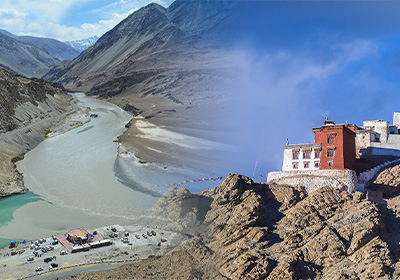
After breakfast, begin a full-day sightseeing tour around Leh and its surroundings. Drive westward along the Indus to Sangam — the breathtaking confluence of the Indus and Zanskar rivers, where the milky-green Zanskar meets the deeper blue Indus in a swirl of contrasting colours framed by sheer cliffs. Enroute visit Gurudwara Pathar Sahib, a Sikh shrine built in 1517 maintained by the Indian Army, and stop at Magnetic Hill for its famous optical illusion where stationary vehicles appear to roll uphill against gravity.
Continue to Hall of Fame Museum — a tribute to the Indian Army's sacrifice in Ladakh's many border battles, with exhibits of weapons, uniforms, and photographs. Return to Leh and ascend to Shanti Stupa — the gleaming white Buddhist peace pagoda built in 1991 — for sweeping 360° views over Leh valley, perfect at golden hour. Then explore the imposing Leh Palace, a nine-storey 17th-century royal fort inspired by Lhasa's Potala Palace, before descending into the market for dinner at a local café. Try staple Ladakhi dishes: thukpa, skyu, or butter tea.
- Breakfast & Dinner
- ~90 km / 2.5 hrs total driving
- Overnight: Leh
-
Day 3 – Leh → Nubra Valley via Khardung La Pass
Nubra
An early start today for the journey to Nubra Valley — one of the most dramatic drives in the world. From Leh, the road climbs steeply northward through a series of switchbacks to Khardung La Pass at 5,359 m (17,582 ft), one of the highest motorable roads on Earth. The pass is marked by prayer flags, an army tea stall, and jaw-dropping views of the Ladakh and Zanskar ranges. Spend 15–20 minutes at the top — the air is thin here, so take it slow — before descending the spectacular northern slopes into the broad, fertile Nubra valley.
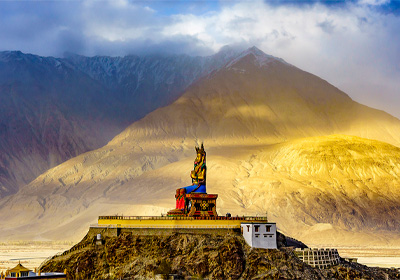
Nubra Valley, historically a key junction on the ancient Silk Route between Ladakh and Central Asia, is a striking contrast of lush green villages, poplar-lined rivers, and barren snow-capped peaks. On arrival, visit Diskit Monastery — Nubra's largest and oldest gompa perched on a rocky cliff, with a magnificent 32-metre Maitreya Buddha statue overlooking the valley. Continue to the golden sand dunes of Hunder for an unforgettable Bactrian camel ride at sunset — the shaggy double-humped camels are a relic of the Silk Route trading era. Check into hotel or luxury camp. Overnight in Nubra Valley.
- Breakfast & Dinner
- ~125 km / 5–6 hrs
- Khardung La: 5,359 m
- Overnight: Nubra Valley
-
Day 4 – Nubra Valley · Turtuk Village Full Day Excursion
After an early breakfast, set off on a full-day excursion to Turtuk — one of the most extraordinary villages in India, located just kilometres from the Line of Control with Pakistan-administered territory. The drive follows the course of the milky-grey Shyok River through a series of remote Balti hamlets: Bogdang, Tyakshi, and Chalunka — each one more scenic than the last, surrounded by towering canyon walls and the distant Karakoram peaks.
Turtuk was part of Pakistan-administered territory until it was liberated by the Indian Army during the 1971 Indo-Pakistan War. Its people are Balti — a distinct ethnic group related to Tibetans but practising Shia Islam — and the village retains an untouched, time-capsule quality that sets it apart from anywhere else in India. Wander through narrow alleyways between traditional mud-brick homes with carved wooden balconies, cross suspension bridges over rushing streams, and explore terraced apricot orchards that cascade down the hillside (spectacular in July when trees are laden with golden fruit). Visit the small but fascinating Balti Heritage Museum and chat with villagers over cups of salt tea. On clear days, the view from the upper village towards Siachen and the Karakoram is one of the finest mountain panoramas you will ever see. Return to Nubra Valley in the evening. Overnight at hotel or camp.
- Breakfast & Dinner
- ~180 km round trip / 6–7 hrs
- Nubra Valley
-
Day 5 – Nubra → Pangong Lake via Shyok Valley
Pangong
Check out from Nubra after breakfast and begin the drive towards the world-famous Pangong Tso via the spectacular Shyok valley route. This road — one of the most scenic in the entire Himalayas — follows the Shyok River through a landscape of extraordinary contrasts: rust-red cliffs, turquoise river bends, abandoned villages, and nomadic tent camps, all set against the backdrop of snow-dusted 6,000-metre peaks.
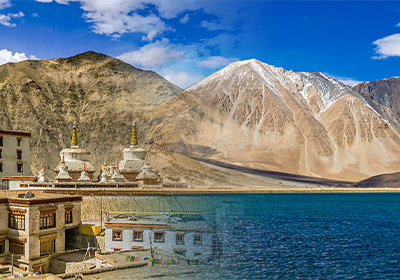
As you approach the Durbuk–Chushul area, the landscape opens into the high Changthang plateau before the road reaches the western tip of Pangong Tso (4,350 m / 14,270 ft). The first view of the lake — a long, mirror-still expanse of vivid turquoise-blue stretching over 134 km into Tibet — is nothing short of breathtaking. The lake became internationally famous after the Bollywood film "3 Idiots" and has since become one of the most iconic images of India's Himalayan frontier. The water changes colour dramatically through the day: deep cobalt at midday, silver in overcast light, and blazing gold at sunset.
Spend the late afternoon walking along the shore, photography, and soaking in the profound stillness. Watch the sunset paint the surrounding Changchenmo mountains in shades of amber and rose. Check into your lakeside camp or cottage. Overnight at Pangong Lake.
- Breakfast & Dinner
- ~160 km / 5–6 hrs
- Pangong Tso: 4,350 m
- Overnight: Pangong Lake
-
Day 6 – Pangong → Tsomoriri Lake via Changthang
Tsomoriri
Wake before dawn for the sunrise over Pangong — as the first light hits the Changchenmo mountains, the lake glows a deep rose-gold that lasts only minutes before shifting back to blue. A moment worth every metre of altitude. After breakfast, begin the drive southeast along the Changthang plateau towards Tsomoriri — one of the most remote and rewarding destinations in all of Ladakh.
The route passes through Chushul (home to Rezang La war memorial, commemorating the heroic 1962 stand of the 13 Kumaon Regiment), then follows the vast open plains of Changthang — the high-altitude cold desert that extends across southern Ladakh and into Tibet. This is nomadic Changpa country: you will encounter herders with their Pashmina goat flocks and yaks, traditional black tents, and a way of life unchanged for centuries. Keep watch for Kiang (Tibetan wild ass), Tibetan gazelle, Himalayan marmots, and the occasional Tibetan wolf.
Arrive at Tsomoriri (4,522 m / 14,836 ft) — the 'Lake of Blue Mountains' — a Ramsar-designated wetland of international importance and one of the world's highest freshwater lakes. At 28 km long and up to 8 km wide, Tsomoriri is flanked by dramatic mountain ridges and fed by glacial streams. Unlike the frequently visited Pangong, Tsomoriri sees far fewer visitors — its shoreline is pristine and its atmosphere is one of profound isolation. In summer the lake hosts breeding colonies of rare black-necked cranes and bar-headed geese — the highest-flying migratory bird in the world. Settle into camp or guesthouse at the village of Korzok on the lake shore. The night sky here is extraordinary. Overnight at Tsomoriri.
- Breakfast & Dinner
- ~210 km / 6–7 hrs
- Tsomoriri: 4,522 m
- Black-necked crane habitat
- Overnight: Tsomoriri Lake
-
Day 7 – Tsomoriri → Leh via Tso Kar & Monasteries
Leh
Rise early for a peaceful sunrise walk along Tsomoriri's glassy shore — with luck, you may spot black-necked cranes taking their first flight of the morning over the water. After a leisurely breakfast, begin the return drive to Leh, passing through the heart of the Changthang plateau.
Enroute, stop at Tso Kar — the 'White Lake', a brackish high-altitude lake whose shores are encrusted with salt deposits left as the water evaporates, creating an otherworldly white landscape. Though smaller than Tsomoriri, Tso Kar is equally magical and hosts flocks of bar-headed geese, ruddy shelducks, and wading birds. Continue north through the fertile Indus valley, stopping at Thiksey Monastery — a spectacular 12-storey gompa that rises in tiers above the Indus plains, with a 15-metre golden Maitreya Buddha at its heart and sweeping views over the valley. A final stop at Hemis Monastery, the wealthiest and most important monastery in Ladakh, home to priceless thangkas, silver and gold stupas, and the annual Hemis Festival (usually June/July). Arrive in Leh by late afternoon. Check into hotel. Free evening for last-minute shopping in Leh bazaar. Overnight in Leh.
- Breakfast & Dinner
- ~320 km / 7–8 hrs with stops
- Enroute: Tso Kar stopover
- Overnight: Leh
-
Day 8 – Departure from Leh
Departure
After breakfast, check out from the hotel and transfer to Kushok Bakula Rimpochee Airport for your onward flight. Depending on your departure time, there may be opportunity for a final stroll through Leh's market for any last souvenirs — the local dried apricots, Himalayan herbal teas, Tibetan prayer flags, and hand-knotted carpets make exceptional keepsakes.
As the aircraft lifts above Leh and the Indus valley unfolds below you — brown mountains streaked with prayer-flag colours, the silver thread of the river, the white dome of Shanti Stupa — carry home the memories of Pangong's impossible blue, Tsomoriri's solitary shore, the Bactrian camels of Hunder, and the quiet grandeur of the Changthang plateau. Ladakh does not let you go easily.
- Breakfast
- Transfer to Leh Airport
Package Cost :
(Package Cost is per person on twin share)
Package Cost
|
Min 2 Adult |
Min 4 Adult |
Min 6 Adult |
Ex. Bed |
Child (5 - 11Y) |
| Superior |
₹ 40100 |
₹ 28200 |
₹ 24200 |
₹ 13800 |
₹ 8600 |
| Premium |
₹ 48400 |
₹ 36500 |
₹ 32500 |
₹ 19800 |
₹ 13400 |
Price Includes
- Accommodation on twin sharing
- Daily breakfast & Dinner at the hotel
- Airport transfers by private vehicle
- Sightseeing by private vehicle as per itinerary
- Driver’s allowance, toll &parking charges and fuel
- All applicable taxes
Price Excludes
- Airfare or train fare
- Personal expenses like laundry, etc.
- Meals other than specified in "Inclusions"
- Guide Service / Entrance to Monuments
- Tips to drivers, guides, and hotel staff
- Any activity/Services not mentioned in “Inclusions”
Hotels Used
| Hotel Used |
Standard |
Superior |
Nights |
Meals |
| Leh |
Northern Singge |
Singge Palace |
3 |
Breakfast & Dinner |
| Nubra |
Hunder Sarai |
Unalome Resort |
2 |
Breakfast & Dinner |
| Pangong |
Crystal Lake Resort |
Misty Hills |
1 |
Breakfast & Dinner |
| Tsomoriri |
Snowcrust Hotel |
Tsomoriri Lake View |
1 |
Breakfast & Dinner |
Frequently Asked Questions
Everything you need to know about your Ladakh trip
The ideal window is late June to mid-September. Tsomoriri's access road from Mahe bridge opens typically by late May/June, and the lake is most spectacular in summer when it is fully thawed and surrounded by wildflowers. For black-necked crane and bar-headed goose sightings, July–August is best as they breed here. By October the road becomes risky due to early snowfall. Pangong and Nubra are accessible May–September. Avoid monsoon flooding risk in the Shyok valley in August by confirming road conditions in advance.
This itinerary requires four separate Inner Line Permits (ILP) for Indian nationals: Nubra Valley, Turtuk (additional protected area permit), Pangong Tso, and Tsomoriri. Foreign nationals require Protected Area Permits (PAP) for all restricted zones. We arrange all permits as part of the package — you need to provide photocopies of your Aadhar/passport and 2 passport photos before travel. Permits are checked at army/police checkposts throughout the journey, so carry originals at all times.
While Pangong is famous worldwide (partly due to Bollywood) and sees thousands of visitors daily in peak season, Tsomoriri remains largely undiscovered. Sitting at 4,522 m — 172 m higher than Pangong — it is a freshwater lake (Pangong is brackish), a Ramsar-designated wetland, and home to much richer wildlife. The surrounding Changthang plateau has a raw, end-of-the-world atmosphere; accommodation is basic (homestays, tents) which itself is part of the authentic appeal. For travellers who have "done" Pangong, Tsomoriri is a revelation.
Tsomoriri's only settlement is Korzok village (pop. ~200) on the lake's western shore. Accommodation is basic by design — homestays run by local Changpa families and simple tented camps with shared or attached bathrooms and blanket-heated rooms. Meals are simple Ladakhi and north Indian food. There is no electricity grid (some solar lighting); mobile connectivity is near-zero. Carry a warm sleeping bag, torch, power bank, and any specific medicines. This rawness is exactly what makes the experience unforgettable. Premium camp options are limited — book well in advance for peak season.
The Changthang Wildlife Sanctuary is one of India's most important protected areas. Commonly sighted species include: Kiang (Tibetan wild ass, best seen near Tsomoriri), Himalayan marmot (abundant near Khardung La), bar-headed geese and black-necked cranes (Tsomoriri, breeding in summer), ruddy shelduck, and Tibetan gazelle. Lucky travellers may spot a snow leopard on rocky hillsides (rare, winter is better), Tibetan wolf, or Pashmina goats and yaks tended by Changpa nomads. Carry binoculars and a telephoto lens.
This itinerary reaches higher altitudes than most standard Ladakh packages. Key altitudes: Leh 3,500 m · Khardung La 5,359 m · Nubra Valley 3,048 m · Pangong 4,350 m · Tsomoriri 4,522 m · Tso Kar 4,530 m. The sustained time above 4,500 m (Pangong + Tsomoriri + Tso Kar) makes this more demanding than a Leh-only tour. We strongly recommend: 2 full nights in Leh before proceeding, Diamox if prescribed, no alcohol for the first 3 days, and honest self-assessment of any pre-existing cardiac or pulmonary conditions. People with severe asthma or heart conditions should seek specialist clearance before booking.
The Pangong → Chushul → Tsomoriri route traverses some of the most remote and unmaintained roads in Ladakh, crossing high-altitude plains via Chushul, Rezang La, and the Mahe bridge. The road is unpaved for long stretches and can be affected by flash floods in August. We use high-clearance 4WD vehicles (Innova Crysta, Fortuner, or Bolero) with experienced mountain drivers. The drive is long (~6–7 hrs) but spectacular. Road conditions are checked before each departure and alternative routes are used if necessary.
Connectivity varies: Leh has good BSNL / Jio 4G. Nubra Valley and Turtuk have patchy BSNL signal only — Turtuk itself has no reliable network. Pangong has minimal to no signal. Tsomoriri and Changthang have no mobile network at all. Foreign SIM cards do not work anywhere in Ladakh. Inform family and contacts of your itinerary and expected offline windows before departing Leh. Consider this a digital detox — the landscapes more than compensate.